
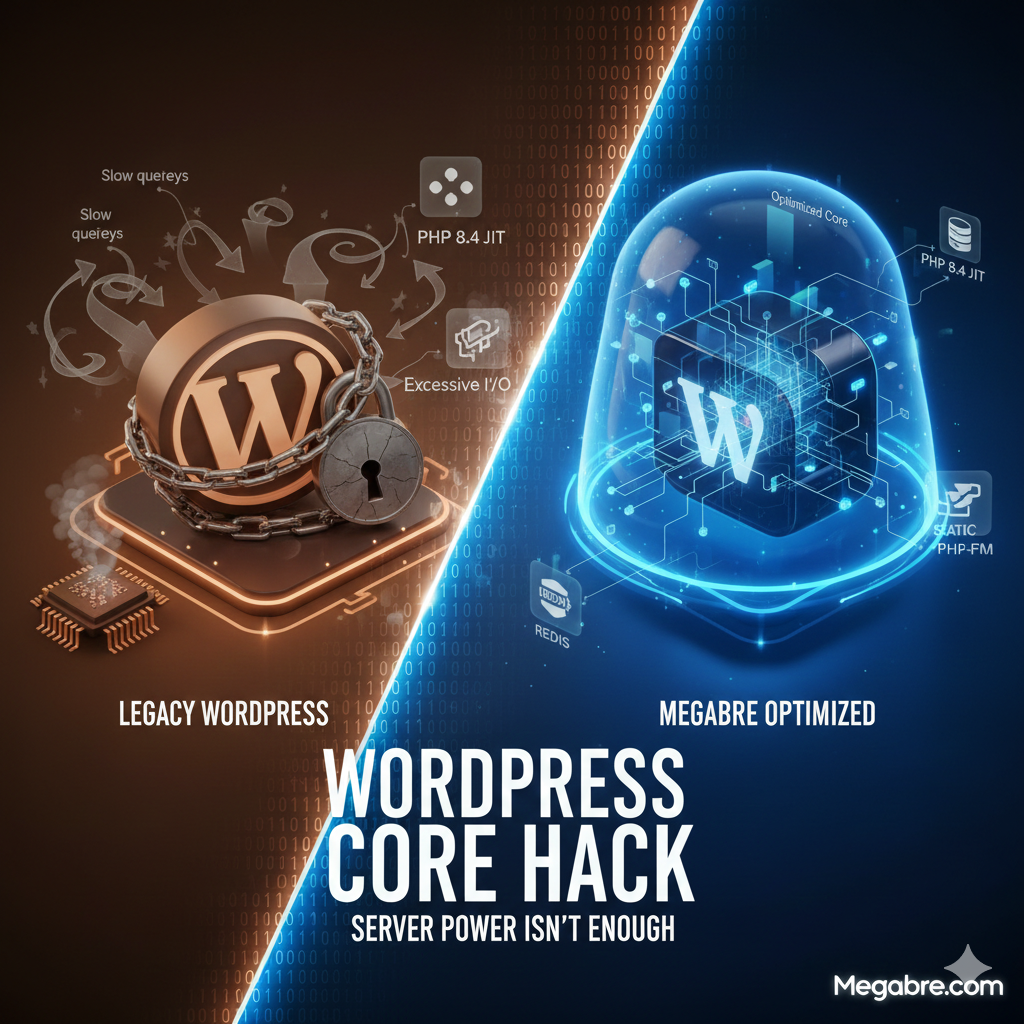
Deep Dive into WordPress Performance Architecture and Core Optimization
In the world of web performance, an abundance of hardware resources (CPU/RAM) is never a substitute for poorly optimized software architecture. In high-traffic environments, bottlenecks typically arise not from a lack of server power, but from inefficiencies in how the WordPress Core interacts with the operating system and database layers.
In this analysis, we move beyond superficial "caching" tactics and explore the advanced optimization layers we implement at Megabre.com.
1. PHP-FPM and Advanced Memory Management
WordPress performance is inherently tied to the configuration of the PHP-FPM (FastCGI Process Manager) pool. Default dynamic management models often lead to "process spawning" latency during sudden traffic surges.
-
Static Process Management: For enterprise scenarios where memory is sufficient, switching to
pm = staticis mandatory. This directs CPU cycles toward handling requests rather than constantly creating and destroying processes. -
OpCache Interned Strings Buffer: Often overlooked, the
opcache.interned_strings_buffershould be increased to 16MB or 32MB. This prevents PHP from redundantly writing the same strings to memory, thereby accelerating memory addressing.
2. Advanced SQL Indexing and Database Layer Strategy
The WordPress database schema carries a heavy JOIN cost in tables with millions of rows—particularly wp_postmeta and wp_options.
-
The Autoload Bottleneck: To prevent "sequential scans" on the
wp_optionstable during autoload queries, custom SQL indexes should be defined where the default indexing falls short. -
Persistent Object Caching (Redis/Memcached): At Megabre, we view Redis not as an option but as a core architectural requirement. By shifting the database
I/Oload to the RAM layer, we minimize I/O Wait times and eliminate disk-bound latency.
3. Eliminating I/O Blocking in WordPress Core
Every page load in WordPress triggers dozens of file system checks via file_exists() and is_readable(). These system calls create micro-delays on the disk.
-
Class Map Autoloading: Moving away from legacy file inclusion toward modern standards or utilizing
opcache.validate_timestamps=0in production environments eliminates constant disk re-validation. -
RAM Disk (tmpfs) Integration: For enterprise projects, hosting translation files (.mo/.po) on a RAM disk (tmpfs) rather than physical storage can shave off critical milliseconds in execution time.
4. Linux Kernel and Network Stack Tuning
Even the most powerful server can be throttled by default OS-level restrictions.
-
TCP Fast Open (TFO): Enabled on Megabre servers, TFO optimizes TLS handshake times, improving Time to First Byte (TTFB) by 10-15%, specifically for mobile users.
-
Keep-Alive and Connection Pooling: Re-opening database connections for every request creates massive CPU overhead under load. Implementing persistent connections is vital for maintaining stability.
5. Modern Asset Orchestration vs. Legacy Concatenation
Combining CSS/JS files is a tactic from the 2010s. In the era of HTTP/2 and HTTP/3, concatenation is often a disadvantage.
-
Resource Prioritization: Instead of merging files, inlining Critical CSS and utilizing
module-based loading for assets allows modern rendering engines (Blink/WebKit) to utilize the main thread more efficiently. -
Asynchronous Decoding: Integrating the
decoding="async"attribute into all media elements at the core level reduces main thread blocking during page render.
The Enterprise Solution: Megabre Engineering
Standard hosting providers offer limits; Megabre.com offers engineering. We provide these advanced parameters pre-optimized within our CloudPanel infrastructure.
If your site feels "heavy" despite low resource usage, you are facing an architectural bottleneck. The Megabre engineering team specializes in identifying these bottlenecks using professional profiling tools to ensure your enterprise WordPress or XenForo project runs at peak efficiency.
Was this answer helpful?
Görüşünüz bizim için değerli!