
OpenPanel vs ISPmanager (EN)
1) Short Summary
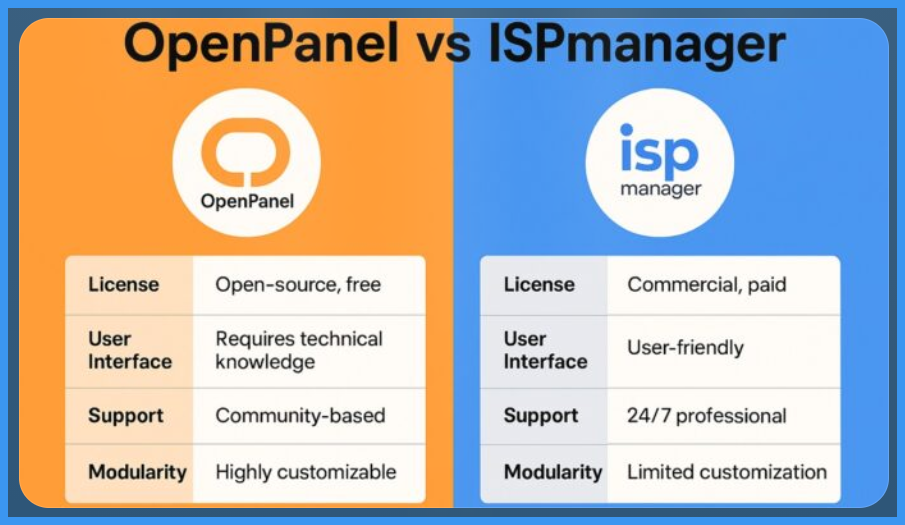
- OpenPanel: Container-based, highly customizable panel; available in Community (free) and Enterprise (paid) editions. Supports multiple web servers (Nginx, Apache, OpenLiteSpeed, OpenResty) and advanced settings like assigning web server/version per user; comes with Docker, OpenCLI, and OpenAdmin components.
- ISPmanager: Commercial (paid) panel; modern interface, built-in backup, security modules (ModSecurity/Fail2ban integrations), multi-language support, and 24/7 professional assistance. Offers Nginx+Apache/OpenLiteSpeed combos, WordPress/Softaculous/Let’s Encrypt automation, billing integrations, and hosting operation modules.
2) Architecture and Technology Stack
OpenPanel
- Container-focused architecture: runs OpenAdmin (admin panel), OpenPanel (user panel), Caddy (reverse proxy/SSL), BIND9 (DNS), MySQL (meta/data), Docker Engine (orchestration).
- Per-user web server and PHP version selection; supports Nginx/Apache/OpenLiteSpeed/OpenResty plus Varnish integration and domain-based cache/purge settings.
- Runs Node.js/Python apps inside containers, proxy routing, and Web Terminal (browser-based container commands) for developer-friendly features.
ISPmanager
- Single panel for managing websites, email, DNS, SSL, databases, cron jobs, backups, and security modules. Supports Nginx + Apache, Nginx + PHP-FPM, OpenLiteSpeed/LiteSpeed combos.
- Includes WordPress Toolkit/1-click installs, Site.pro/Sitejet builders, and Let’s Encrypt automated certificate management.
- Integrates with BILLmanager/WHMCS/Blesta/HostBill for billing and reseller hosting workflows.
3) Security and Isolation
OpenPanel
- Strengthens user isolation at container level; per-user configuration (e.g., custom Nginx/OpenResty location/Lua logic) and domain-based caching/buffering rules for fine-tuned control.
- SSL/auto-renewal, php.ini limits, Redis/Memcached object caching with user-specific restrictions.
ISPmanager
- Built-in security modules: ModSecurity (WAF), Fail2ban, antivirus (ImunifyAV/ClamAV), DDoS-GUARD, and automated backups for operational security.
- User/role management, 2FA, separate mail/domain policies, and anti-spam features like greylisting/SpamAssassin.
4) Installation, Usability, and Operations
- OpenPanel: Installation guides mention 15–30 minutes; workflow: OpenAdmin → create user → OpenPanel access (ports 2083 for user, 2087 for admin). CLI automation via opencli.
- ISPmanager: All-in-one interface; easier learning curve for beginners. Multi-language support and visual wizards speed up daily tasks.
5) Licensing and Cost
- OpenPanel: Community (free) and Enterprise (paid) models. Enterprise offers more features, premium support, and SLAs.
- ISPmanager: Fully commercial license; pricing scales by user/site count and modules. Advantage: official support and maintained built-in modules.
Note: ISPmanager pricing varies by region and distribution channels; official site provides the latest trial/demo and license info.
6) Performance and Scalability
- OpenPanel: Allows different web servers/PHP versions per user on the same server, domain-based FastCGI/LSCache/Varnish/URL rewrite settings for optimized workloads.
- ISPmanager: Simplifies proven combos like Nginx + Apache or Nginx + PHP-FPM; WordPress Toolkit and caching mechanisms aim for stable performance in typical web workloads.
7) Which Scenario Fits Which?
- Developer-focused VPS, agency multi-tenant environments (test/QA/production): If you need per-site web server/PHP flexibility, container isolation, and OpenCLI automation, OpenPanel is advantageous.
- Hosting providers, reseller operations, enterprise support needs: ISPmanager offers ready-to-use experience with built-in backups, anti-spam/antivirus/WAF, billing integrations, and multi-language support.
Feature Comparison Table
| Category | OpenPanel | ISPmanager |
|---|---|---|
| Version/Model | Community (free), Enterprise (paid) | Commercial license (various plans) |
| Architecture | Docker/container-based; OpenAdmin + OpenPanel + Caddy + BIND9 + MySQL | Integrated modules; hosting-focused workflows |
| Web Servers | Nginx, Apache, OpenLiteSpeed, OpenResty, Varnish integration; per-user/domain config | Nginx + Apache, Nginx + PHP-FPM, OpenLiteSpeed/LiteSpeed |
| Languages | PHP (multi-version per domain), Node.js, Python (containerized) | PHP multi-version, Node.js, Python support |
| Databases | MySQL; Redis/Memcached caching options | MySQL/MariaDB/Percona/PostgreSQL |
| DNS/SSL | BIND9; auto SSL issuance/renewal | Built-in DNS/SSL; Let’s Encrypt automation |
| Security | Container isolation; per-domain cache/limits | ModSecurity, Fail2ban, antivirus, DDoS-GUARD, 2FA |
| Backup | Panel/remote strategies; domain-based backups | Built-in scheduling + remote storage |
| Automation | OpenCLI, API; scriptable setups | Billing (BILLmanager/WHMCS/Blesta) integrations |
| Usability | High flexibility for DevOps; fine-tuning | Out-of-the-box experience; multi-language, wizards |
| Support | Community + Enterprise premium support | Official 24/7 support, docs/demos |
| Target Audience | Agencies, developers, sysadmins neding customization | Hosting providers, resellers, enterprise teams |
Conclusion and Recommendation
- If fine-tuning/customization + container isolation is critical, and you want to assign different web servers/PHP versions per site and run Node/Python apps via panel, OpenPanel is a strong choice. Start with Community, upgrade to Enterprise as operations grow.
- If hosting operations, reseller model, built-in security and backups + official support are priorities, ISPmanager delivers faster value. Its billing/support ecosystem and multi-language interface ease team adoption.
References
- https://openpanel.com/features
- https://github.com/stefanpejcic/openpanel
- https://hostkey.com/documentation/tr/marketplace/hostingcontrolpanels/openpanel/
- https://euro-stack.com/solutions/openpanel
- https://www.ispmanager.com/tr
- https://www.ispmanager.com/blog/cpanel-vs-ispmanager-which-is-best-in-2025